What Is a Power Transformer? Function, Types, and Selection Guide
A power transformer transfers electrical energy between circuits at different voltage levels through electromagnetic induction — no moving parts, no change in frequency.
Specify the wrong type for your voltage class or installation environment and your project waits weeks for a replacement unit. This guide covers how a power transformer works, the four main types — oil-immersed, dry-type, pad-mounted, and substation-class — and how to match the right design to your project’s voltage class, installation environment, and certification requirements.
How a Power Transformer Works
When alternating current flows through the primary winding, it creates a time-varying magnetic flux in the laminated steel core. That flux induces a voltage in the secondary winding. The ratio of primary turns to secondary turns — the turns ratio — sets whether the device steps voltage up or down. A 10:1 turns ratio steps 13.8 kV down to 1.38 kV; your load sees the lower voltage while the upstream grid sees only the high-voltage source.
Frequency stays constant throughout this process. What changes is voltage, and inversely, current. This is why the same transformer that serves a 60 Hz North American grid cannot simply be re-rated for 50 Hz service without re-engineering the core design for the new frequency’s flux requirements.
Primary windingLaminated steel coreSecondary windingHV inLV out
Types of Power Transformers
The four types below all operate on the same electromagnetic principle. Your selection turns on voltage class, installation environment, code requirements, and total installed cost — not on which type sounds most familiar. For the ratings and configurations we build, see our power transformer page.
Oil-immersedDry-typePad-mountedSubstation-classOutdoor / vaultIndoor / cleanGround-level / publicTransmission / HVMineral oil or esterCast resin / VPIOil, dead-front cabinetOil, OLTC, forced cool300 kVA – 5 MVA+15 kVA – 2,500 kVA45 kVA – 5,000 kVA1 MVA – 1,000+ MVAOil containment req’dHigher cost >1 MVA15–36 kV primary onlyLonger lead time
Oil-Immersed (Liquid-Filled) Transformers
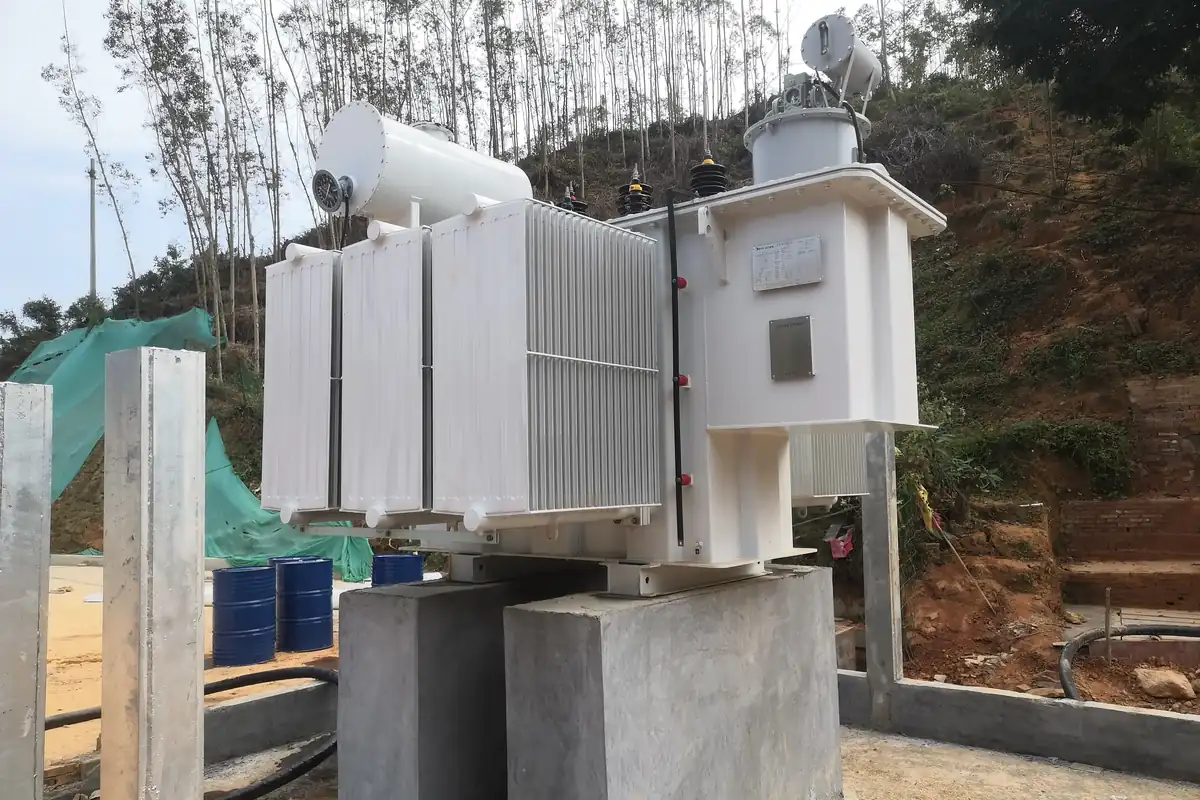
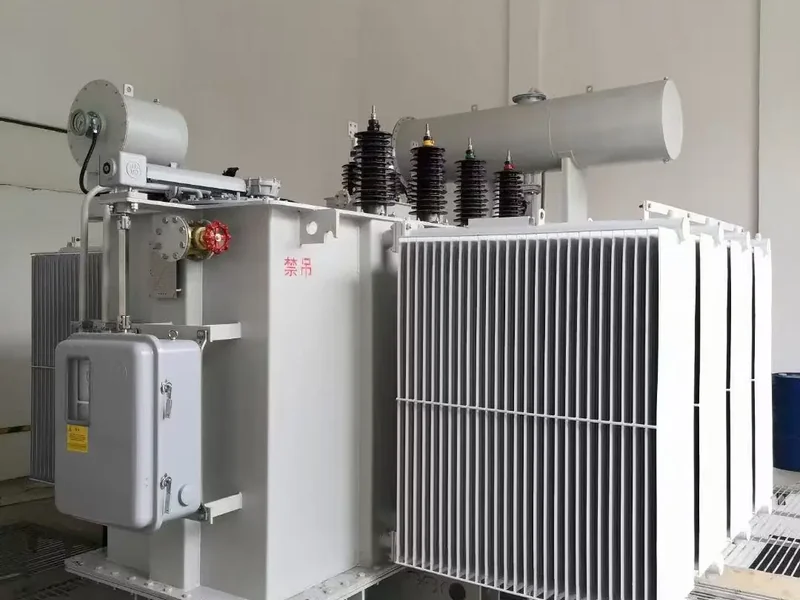
What makes them distinct. The core and windings sit submerged in dielectric mineral oil or natural ester fluid inside a sealed steel tank. Oil handles both insulation and cooling, giving these units higher thermal overload tolerance than dry-type designs at equivalent kVA ratings.
What that means for your project. Liquid-immersed units are the standard choice for outdoor substations, utility distribution, and industrial facilities above roughly 300 kVA. They deliver the lowest no-load losses per kVA and the most mature supply chain for large ratings. If your project is outdoors or in a dedicated vault and sits at 500 kVA or above, this is the design you will encounter most often in utility and EPC specifications.
What to watch out for. Oil requires a containment system — typically a concrete berm or integral oil-tight basin — to meet environmental regulations. Indoor installation requires either a fire-rated vault or a switch to natural ester fluid, which has a significantly higher flash point than mineral oil. Factor the containment civil work into your total installed cost comparison.
Dry-Type Transformers
What makes them distinct. Instead of liquid insulation, dry-type units use cast-resin encapsulation or vacuum-pressure impregnated (VPI) windings. No oil means no spill risk and no oil-related maintenance intervals.
What that means for your project. Dry-type transformers are the preferred solution inside occupied buildings, data centers, hospitals, tunnels, and offshore platforms — anywhere that liquid spillage is unacceptable or fire risk must be minimised. If your AHJ prohibits liquid-filled units indoors, your path is dry-type.
What to watch out for. Dry-type units cost more per kVA than equivalent oil-filled designs above roughly 1,000 kVA, and their overload tolerance is lower. They also produce more audible noise under load, which matters in occupied spaces. Above certain ratings, the physical footprint grows substantially and cooling requirements become more demanding.
Pad-Mounted Distribution Transformers
What makes them distinct. A pad-mounted transformer places an oil-immersed core and winding assembly inside a tamper-resistant, ground-level steel cabinet with dead-front primary connections. All live parts are fully enclosed — no exposed conductors — making these units safe in areas where the public has access.
What that means for your project. Pad-mounted units are the standard interface between the utility medium-voltage grid and your building or campus secondary. You will find them in residential subdivisions, shopping centers, campuses, and any urban or suburban project where an overhead pole mount is impractical or not permitted. Your crew works on de-energised cable ends, not live bushings — a meaningful safety difference during energisation and maintenance.
What to watch out for. Primary voltage range matters: verify your utility’s nominal primary voltage before you specify. Standard three-phase pad-mounted designs cover 15–36 kV primary; a 4.16 kV primary system requires a different product family. See padmount transformer ratings and configurations to confirm your voltage class is covered before finalising your specification package.
Utility MVPad-mountedTransformerDead-front cabinetBuilding loadConcrete pad + containment
Substation-Class Power Transformers
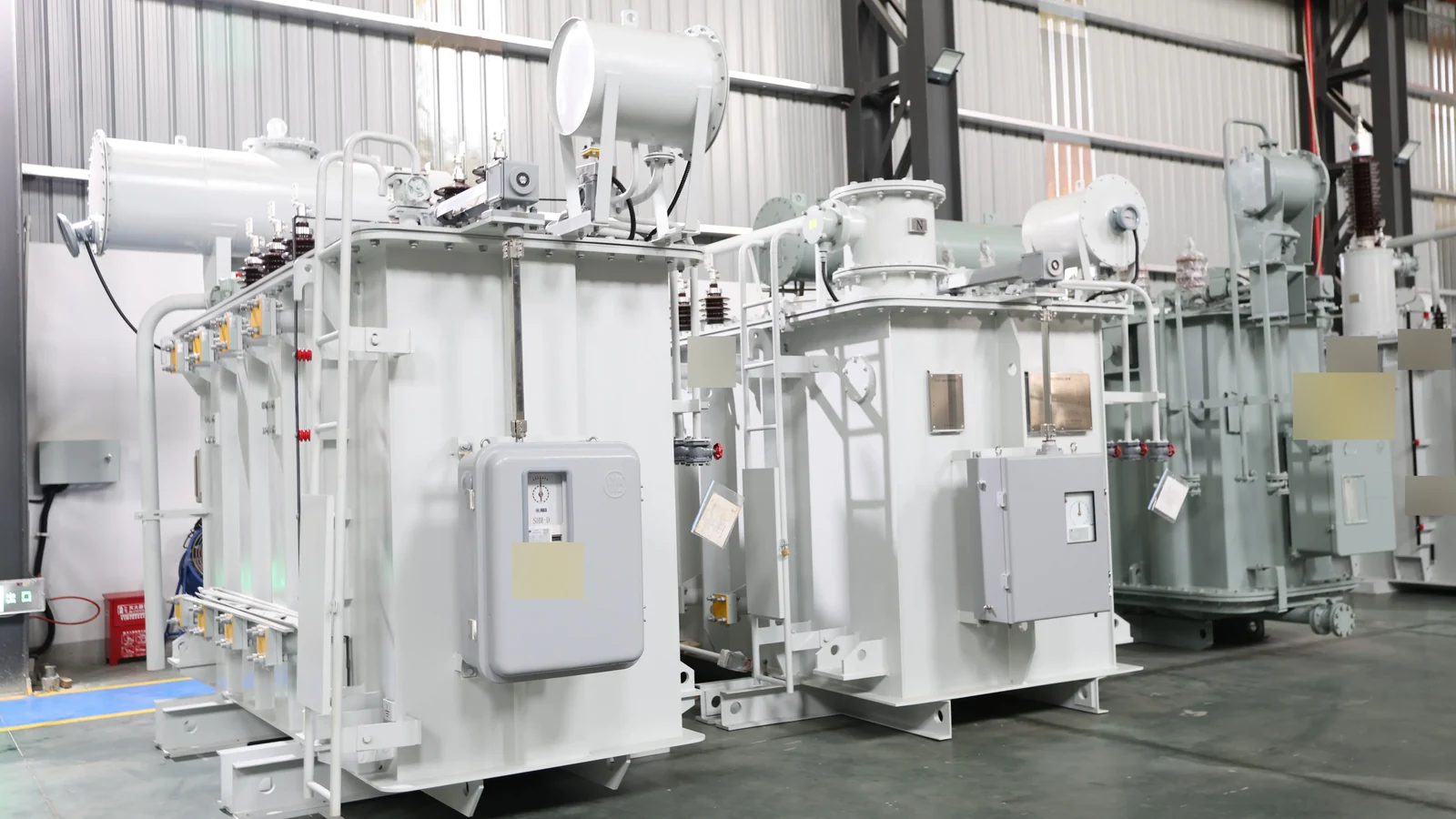
What makes them distinct. Substation transformers handle bulk power transmission, typically with primary voltages from 69 kV through 765 kV and ratings measured in MVA. They are engineered to order and include on-load tap changers (OLTCs), dedicated protection relaying schemes, and often forced-cooling systems.
What that means for your project. If your project connects at transmission voltage — a large industrial load, a renewable generation interconnect, or a utility substation upgrade — you are in substation transformer territory. Your specification package will reference IEEE C57.12.00 and your utility’s own technical requirements, and factory acceptance testing at full voltage is a standard contractual milestone.
What to watch out for. Lead times for engineer-to-order substation units are substantially longer than for distribution-class equipment. Site civil work — foundations, oil containment, bus work, protective relay panels — is more extensive. Current transformer lead time data for 2026 gives you a realistic planning baseline for both distribution and larger-class equipment when building your procurement schedule.
How to Choose a Power Transformer
Work through these four dimensions in order. Voltage class is fixed by your grid and cannot be negotiated; kVA sizing, environment, and certifications all depend on it.
1Voltage classSet by your grid2kVA ratingLoad × 1.25, round up3EnvironmentIndoor / outdoor / public4CertificationsAHJ + utility req.
Match Your Voltage Class to the Grid
Your utility’s primary voltage is fixed. Confirm the exact nominal voltage and ask the manufacturer what tap positions are available if the delivered primary may differ from nominal by more than a few percent. Most distribution transformers include ±2.5% or ±5% no-load taps for this purpose.
Your secondary voltage and phase count determine the winding configuration. Confirm whether your load requires a delta or wye secondary, and whether your system needs a neutral conductor — many loads in the 208Y/120 V or 480Y/277 V range require a solidly grounded wye secondary with a centre-point neutral.
Size the kVA Rating for Your Load
Transformer kVA reflects the maximum continuous apparent power at rated voltage and temperature. Your starting point is connected load in kVA, but that figure alone understates your requirement: motor starting inrush, harmonic-generating equipment, and future load growth all push the required rating higher than your nameplate connected load suggests.
A common approach for commercial and industrial applications is to size at 125% of your calculated connected load, then snap to the nearest standard kVA step. If your loads include significant variable-frequency drives or UPS systems, ask whether a K-factor rated unit is required — K-factor ratings account for the elevated harmonic content that non-linear loads impose on transformer losses and temperature rise.
Connected load(kVA)×1.25Sizing target(kVA)→ next std.Order kVAratinge.g. 350 kVA load350 × 1.25 = 437.5 kVAOrder 500 kVA
Factor In the Installation Environment
Where the transformer lives determines the allowable insulation system and enclosure type. Outdoor ground-level installations with public access favour pad-mounted designs. Vaults inside buildings require units that meet the vault’s fire-resistance and ventilation requirements. Locations with high ambient temperatures, coastal salt spray, or elevation above 1,000 m each require specific de-rating or design modifications.
Your environment also defines your maintenance program. Liquid-filled units require periodic oil sampling and dielectric testing. Dry-type units require regular inspection for dust accumulation on windings. Build both into your total cost of ownership calculation before you make a final selection.
Certifications and Standards Your Project Requires
In the United States, your AHJ and utility may require that the transformer carry a specific listing or comply with a specified standard. IEEE C57.12.00 covers general requirements for liquid-immersed distribution and power transformers; ANSI C57.12.20 and C57.12.21 address specific pole-mount and pad-mount requirements.
IEEE C57.12.00Liquid-immerseddistribution & powerGeneral requirements+ C57.12.20 / .21 padIEEE C57.12.01Dry-type distribution& power transformersGeneral requirementsIndoor / enclosureIEC 60076Power transformersinternational seriesParts 1–8 coverlosses, insulation, testing
For projects outside North America, IEC 60076 is the applicable series — confirm with your engineer of record which clauses govern your voltage class and cooling designation.
Transformer nameplate (schematic) [ kVA ] [ Primary V ] [ Secondary V ] [ Impedance %Z ] [ Tap positions ] [ Weight ] [ Fluid type ] [ Cooling class ] [ Standards: IEEE / ANSI / IEC ] Confirm all nameplate values match your approved specification before energising.
Frequently Asked Questions
What is the difference between a power transformer and a distribution transformer?
The distinction is primarily one of voltage class and rating. Distribution transformers typically operate at primary voltages below 35 kV and ratings below 5,000 kVA, serving the final step-down to utilisation voltage. Power transformers handle higher voltages and larger MVA ratings, connecting the transmission and sub-transmission layers of the grid. In practice the boundary is not rigid, and your project specification should reference the governing standard — IEEE C57.12.00 for liquid-immersed, IEEE C57.12.01 for dry-type — rather than relying on a generic label.
How long does it take to get a power transformer?
Standard distribution-class pad-mounted and dry-type units typically deliver within 5–8 weeks from contract. Larger engineer-to-order substation units take considerably longer — factor your transformer lead time into your project schedule early and verify current availability with your supplier. Volume delivery schedules are confirmed per project.
Can a transformer operate at a voltage different from its nameplate rating?
Yes, within the tap range built into the unit. Most distribution transformers include ±5% no-load taps, letting the transformer compensate for a utility primary that runs slightly above or below nominal. Operating outside the tap range — or running a 60 Hz transformer on 50 Hz — requires engineering review. Sustained over-voltage or under-frequency operation increases core losses and can cause overheating.
What does the kVA rating on a transformer nameplate mean?
kVA is the product of rated voltage and rated current at the rated power factor and temperature rise, divided by 1,000. It is the maximum apparent power the transformer can continuously deliver without exceeding its thermal limit. Your actual load in kilowatts will be lower than the kVA figure by a factor equal to your load’s power factor. Specify kVA when ordering, not kW alone.
Does a power transformer change the frequency of the power it delivers?
No. A transformer is a static device with no rotating parts and performs no frequency conversion. Output frequency always equals input frequency. If your project requires frequency conversion — for example, connecting 60 Hz equipment to a 50 Hz grid — you need a motor-generator set or solid-state frequency converter, not a transformer.
What is the purpose of the transformer core?
The core provides a low-reluctance magnetic path that concentrates the flux linking the primary and secondary windings. Without the core, mutual inductance would be too low to transfer power efficiently. The core is built from thin laminations of grain-oriented silicon steel — or amorphous alloy in high-efficiency designs — to minimise eddy-current losses at operating frequency.
Final Thoughts
Voltage class, kVA rating, insulation system, and applicable standards: get those four right and the physical design — oil-filled, dry-type, pad-mounted, or substation class — follows logically from your site and code requirements. If you want those four checked against a specific project before you buy, YGT Volt quotes to drawing rather than to a catalogue line.